$ cat vip/README.md
VIP: EM Virtual Playground
Vertically Integrated Partnership for Exoplanetary Sciences

About the Program
The VIP (Vertically Integrated Partnership) program is a collaborative initiative between Howard University and NASA's Jet Propulsion Laboratory (JPL) focused on advancing planetary and exoplanetary sciences. Through this partnership, we are developing the EM Virtual Playground, an interactive computational tool that visualizes the generation, propagation, and interaction of electromagnetic waves.
The EM Virtual Playground features a Python GUI frontend coupled with a scientific computing backend, enabling students to conduct virtual experiments with different electromagnetic sources, materials, and geometries. Users can visualize antenna radiation patterns, wave scattering, diffraction phenomena, and more, making abstract EM concepts tangible and interactive.
Through this vertically integrated approach, the program creates a mentoring chain where senior graduate students guide junior students and undergraduates, fostering a sustainable research community and providing a pathway for underrepresented students to pursue careers in space science and engineering.
Team
Dr. Su Yan
Faculty Advisor
Associate Professor, EECS
Minyechil Mekonnen
Graduate Assistant
Ph.D. Candidate
EM Virtual Playground Features
📡 Antenna Radiation
Visualize radiation patterns from various antenna types, including dipoles, arrays, and aperture antennas.
🌊 Wave Scattering
Simulate electromagnetic wave scattering from objects of various shapes, sizes, and materials.
🔬 Diffraction Visualization
Explore diffraction phenomena with different aperture geometries and wavelengths.
🎛️ Interactive Experiments
Python GUI frontend with real-time parameter tuning for sources, materials, and geometries.
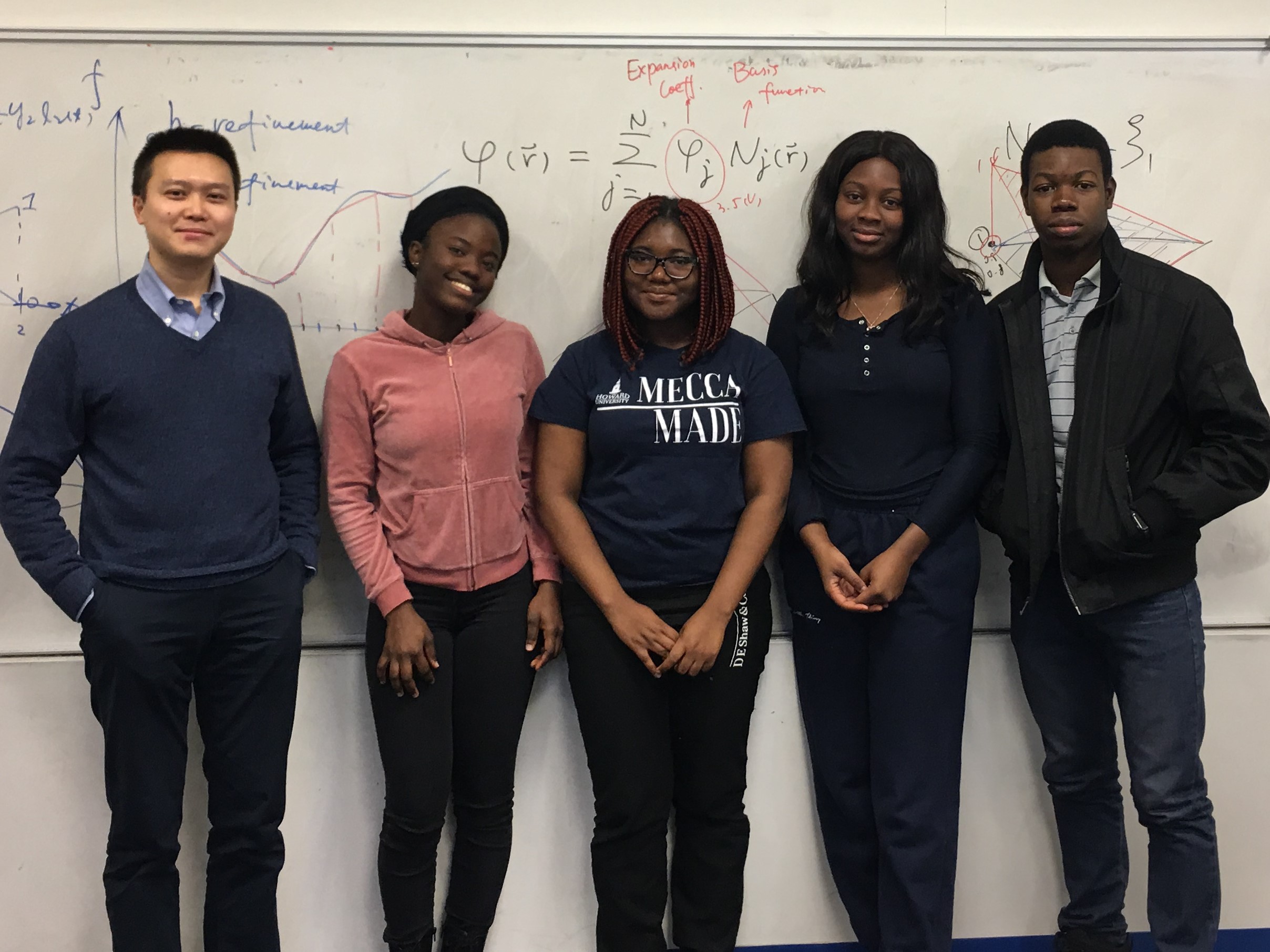
VIP Program Team
Past Team Members
Olaide R. Afolabi
Faith T. Adegbenro
Nana-Akua Ofosu
Oluwatamilor E. Ogunbanjo
Javid Mitchell
Funding
This program is supported by NASA Jet Propulsion Laboratory through the grant “Establishing a Vertically Integrated Partnership with Howard University through Planetary and Exoplanetary Sciences” (October 2022 to September 2024). Prior collaboration with JPL began in January 2020 with a coronagraph design project for ExoEarth observations.