$ cat research/intelligent.md
Intelligent Methods for Reconfigurable Devices
The rapid development of communication, sensing, and navigation systems are driving major changes in next-generation RF and microwave devices. These devices need to be miniaturized, integrated, capable of working in multiband and multimode, and configured via software-defined signals or user-centric artificial intelligence (AI) for systems possessing perception, learning, reasoning, and decision-making capabilities.
Fabricated by functional materials and engineered metasurfaces, these devices are tunable and reconfigurable through external stimuli such as biasing voltages, electrical/magnetic/optical excitations, temperature variations, and mechanical forces. While the reconfigurability provides unprecedented flexibility, the design and optimization face great challenges from structural and material complexities, multi-scale challenges, multiphysics and nonlinear interactions, and high optimization dimensionalities.
The primary objective is to confront these challenges by developing physics and neural network enabled EM and multiphysics simulation methods. These methods provide multi-scale, multiphysics, and nonlinear modeling capabilities, enabling efficient evaluation and optimization of RF and microwave reconfigurable devices. Recent work includes adaptive multi-grid graph element networks for PDE solutions on irregular finite element meshes, and discontinuous Galerkin integral equation methods with generalized sheet transmission conditions for metasurface modeling.
> examples
Dynamic p-adaptation for electromagnetic simulations
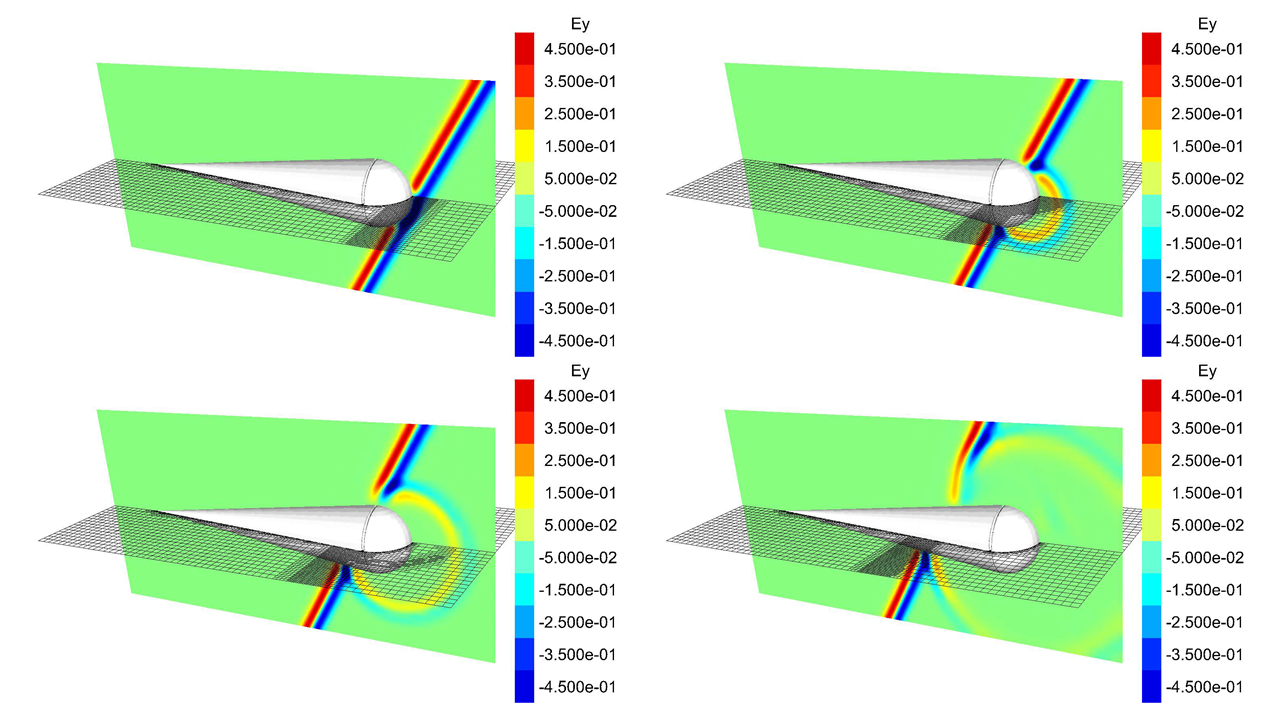
Dynamic h-adaptation, mesh automatically refines
AI-aided design and optimization of metasurface devices
Adaptive multi-grid graph element networks for PDE solutions on irregular FEM meshes
Discontinuous Galerkin integral equation for metasurface modeling with GSTC
> funding_agencies
> key_publications
Nonlinear finite element analysis of thermal runaway in microwave-heated shale using a C∞ smooth conductivity model
M. Anee and Su Yan, Proc. IEEE MTT-S Int. Conf. Numer. Electromagn. Multiphys. Model. Optim. (NEMO), Valencia, Spain, July, 2026
A domain-decomposed A-φ formulation with curved nonconformal interfaces
A. Hossain and Su Yan, Proc. IEEE Antennas Propag. Symp., Detroit, MI, USA, July, 2026
A Neumann-Neumann preconditioned domain decomposition method for A-φ formulation
J. A. Haider and Su Yan, Proc. IEEE Antennas Propag. Symp., Detroit, MI, USA, July, 2026
A domain-decomposed A-φ formulation with nonconformal planar interfaces
A. Hossain and Su Yan, 2026 International Applied Computational Electromagnetics Society (ACES) Symposium, Thessaloniki, Greece, May, 2026
Neumann-Neumann preconditioning for domain decomposed A-φ formulation
J. A. Haider and Su Yan, 2026 International Applied Computational Electromagnetics Society (ACES) Symposium, Thessaloniki, Greece, May, 2026
A domain-decomposed A-φ formulation based on Lagrange multipliers for low-frequency problems
A. Hossain and Su Yan, Proc. IEEE Antennas Propag. Symp., Ottawa, Canada, July, 2025
Time-domain all-frequency stable formulation for low-frequency electromagnetic simulation with Newmark-beta time integration
M. Mekonnen and Su Yan, Proc. IEEE Antennas Propag. Symp., Ottawa, Canada, July, 2025
A stable potential-based time-domain method for wideband electromagnetic analysis
M. Mekonnen and Su Yan, 2025 International Applied Computational Electromagnetics Society (ACES) Symposium, Orlando, FL, USA, May, 2025